PRODUCT OVERVIEW
This project is a digital platform that helps employees across the UK engage with ESG goals by tracking simple environmental actions like reducing energy use, limiting printing, and choosing sustainable commuting options. Users can monitor their impact and stay motivated through challenges, badges, and leaderboards. The platform is designed to be easy to use for all employees (office-based, hybrid and remote), while providing users and organisations with insights for ESG reporting and sustainability planning.
THE PROBLEM:
In hybrid and remote environments, employees lack an easy-to-use, interactive, and inspiring way to track and maintain sustainable behaviours beyond the office. As a result, participation drops because users don’t get enough feedback, recognition, or rewards and organisations miss the chance to measure progress and document sustainability efforts properly.
WHY THIS MATTERS:
When sustainability actions aren’t visible or reinforced:
Employees feel disconnected from ESG strategy
Motivation reduces over time
Organisations lose valuable data needed for reporting and decision-making
Scaling voluntary sustainability programs becomes difficult
GOAL
Design a user-centered digital solution that enables employees to track, improve, and celebrate sustainable behaviours at home and at work while supporting individual engagement, collective impact, and alignment with an organisation’s broader ESG mission (starting with Environmental, and expanding to Social and Governance over time).
My Role
I led the UX process end-to-end:
Defined the problem and goals
Conducted mixed-method research
Synthesised insights and created the product direction
Designed user flows and low-fidelity prototypes
Ran usability testing and iterated based on evidence
TARGET USERS:
The solution is designed primarily for:
Everyone (users)
Office-based employees
Remote and hybrid employees
Other relevant organisational stakeholders
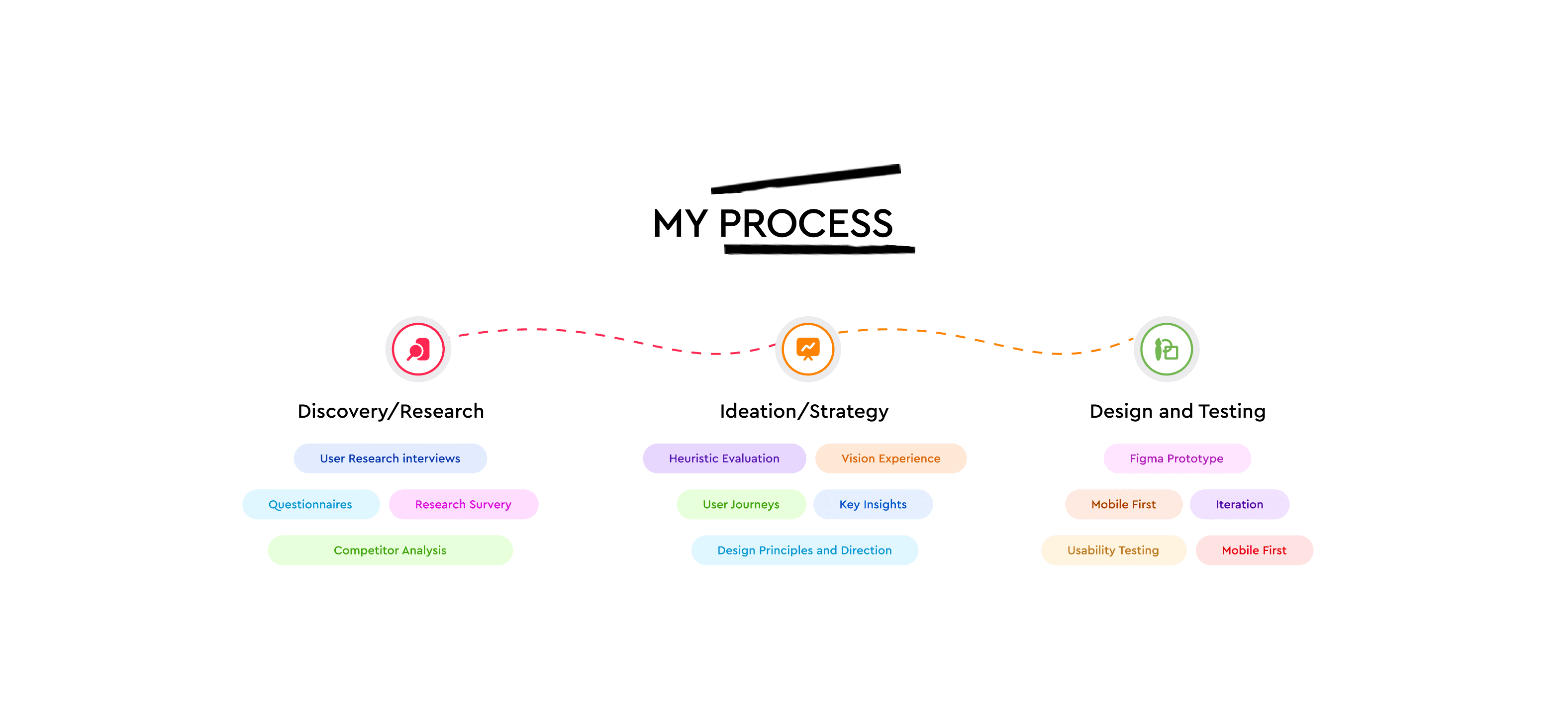
RESEARCH METHOD
To establish a strong foundation for the product, I conducted mixed-method research (quantitative and qualitative research) to understand user behavior, awareness levels, motivations, and challenges around ESG participation.
QUANTITATIVE RESEARCH:
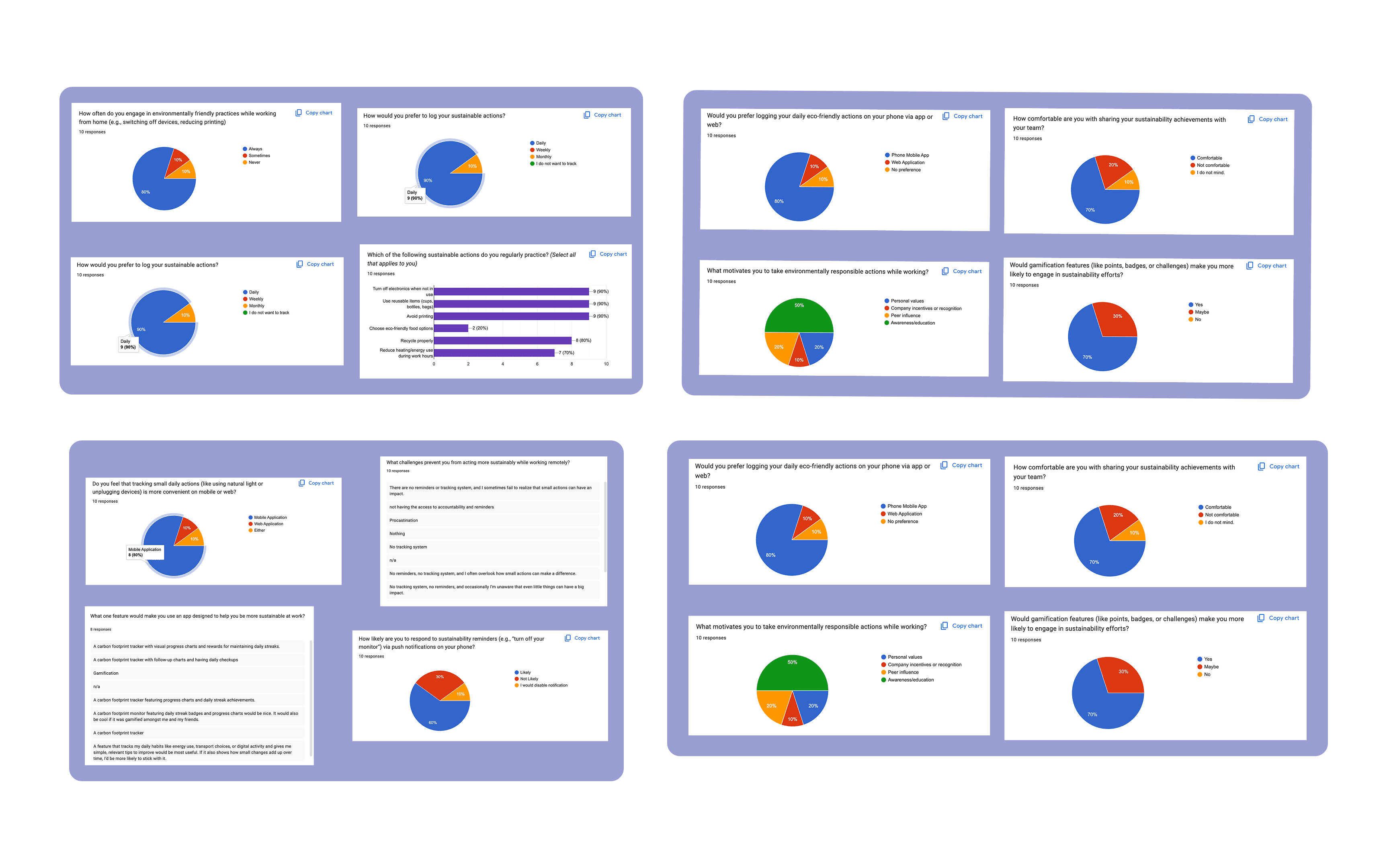
I used surveys to collect broad insights on ESG awareness, current participation levels, barriers, and what motivates users to take sustainable actions. This helped me identify patterns across a wider population and measure common behaviours statistically.
QUALITATIVE RESEARCH:
I conducted user interviews with different users to go deeper into the “why” behind user choices exploring what ESG means to people personally, what frustrates them, and how they would like to engage with sustainability within their workplace and daily routines. I also gathered recognizable patterns and used them to come with a problem statement.
KEY PATTERNS AND NOTES
Overall: Users are motivated to contribute to sustainability but struggle with consistency due to the lack of structure, feedback, and seamless tracking. Users want an app that makes logging easy, feels voluntary, provides encouragement, and connects their personal actions to a broader shared impact especially within the workplace. They also respond strongly to autonomy, positive reinforcement, and clear value messaging, which are all key factors that will influence retention and long-term engagement.
COMPETITIVE ANALYIS:
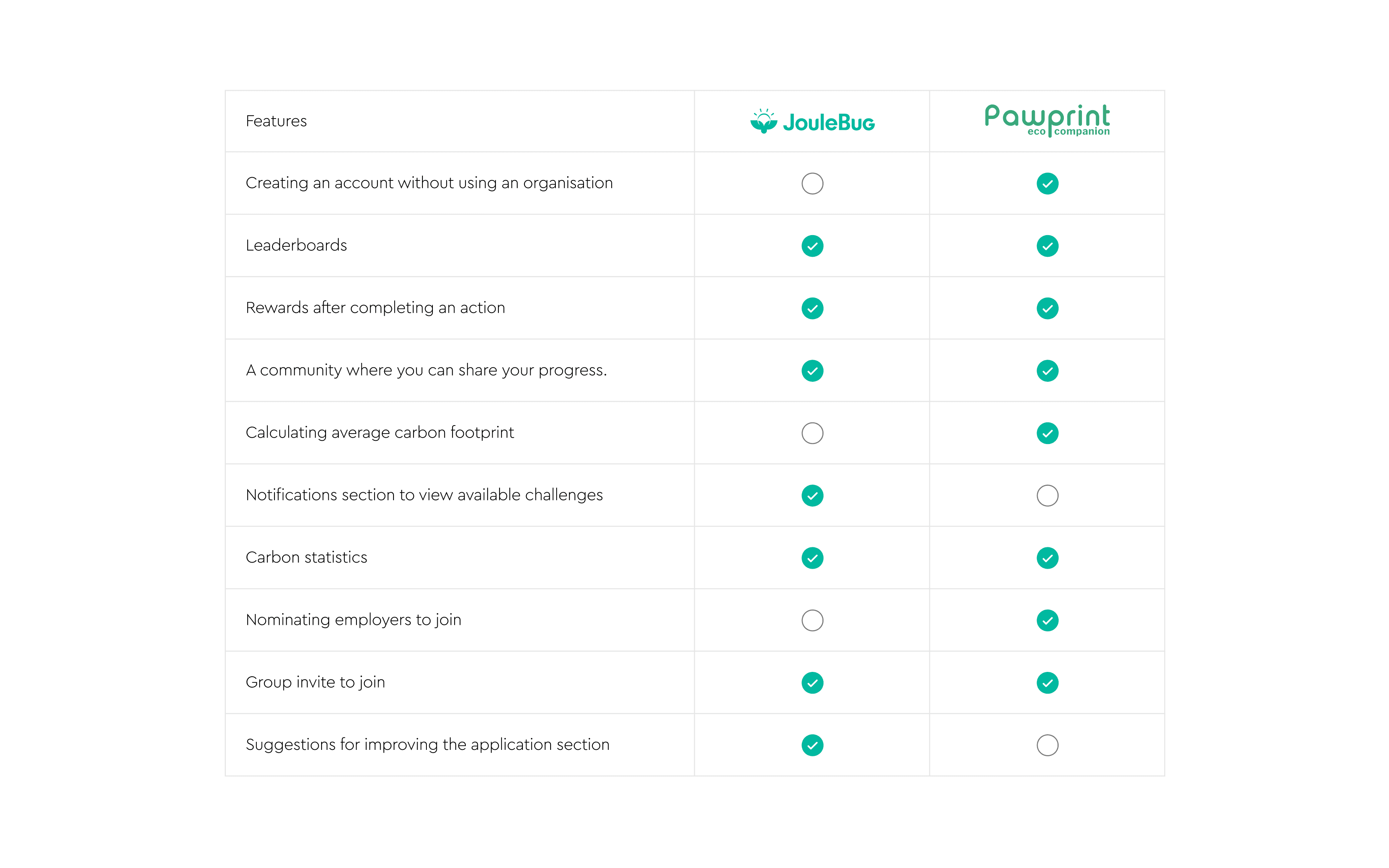
I reviewed existing sustainability and ESG-related tracking tools to identify what works and what fails.
KEY LEARNINGS:
Gamification (points, badges, leaderboards, challenges) helps motivation
But many tools still rely on heavy manual input, limited notifications, and friction that reduces long-term adoption
This guided a core principle for my concept: make logging easy, and make motivation automatic.
USER PERSONAS
PERSONA 1: (SARAH) Remote Worker
Sarah works from home, likes tracking her routines with apps, and cares about the environment, but struggles to see how her actions connect to company goals. She wants a simple way to log actions, get instant feedback, and receive light reminders that don’t interrupt her work.
PERSONA 2: (DANIEL) Hybrid
Daniel works hybrid (office + home). He wants consistency across both environments, prefers mobile-first tools, and wants a gamified experience that fits into his schedule. He’s motivated by progress feedback and healthy competition, and wants the tool to work smoothly with his calendar/task list.
IDEATION AND DESIGN DIRECTION
Mobile-First is better than Web, because users need to log actions anywhere (home, office, commuting).
Motivation must come from:
rewards + recognition
clear progress feedback
challenges and optional leaderboard
reminders that support, not stress users
The experience must be accessible and inclusive (e.g. dark mode, screen reader compatibility).
APPLICATION FEATURES AND FUNCTIONALITIES: After research, major key notes to take are:
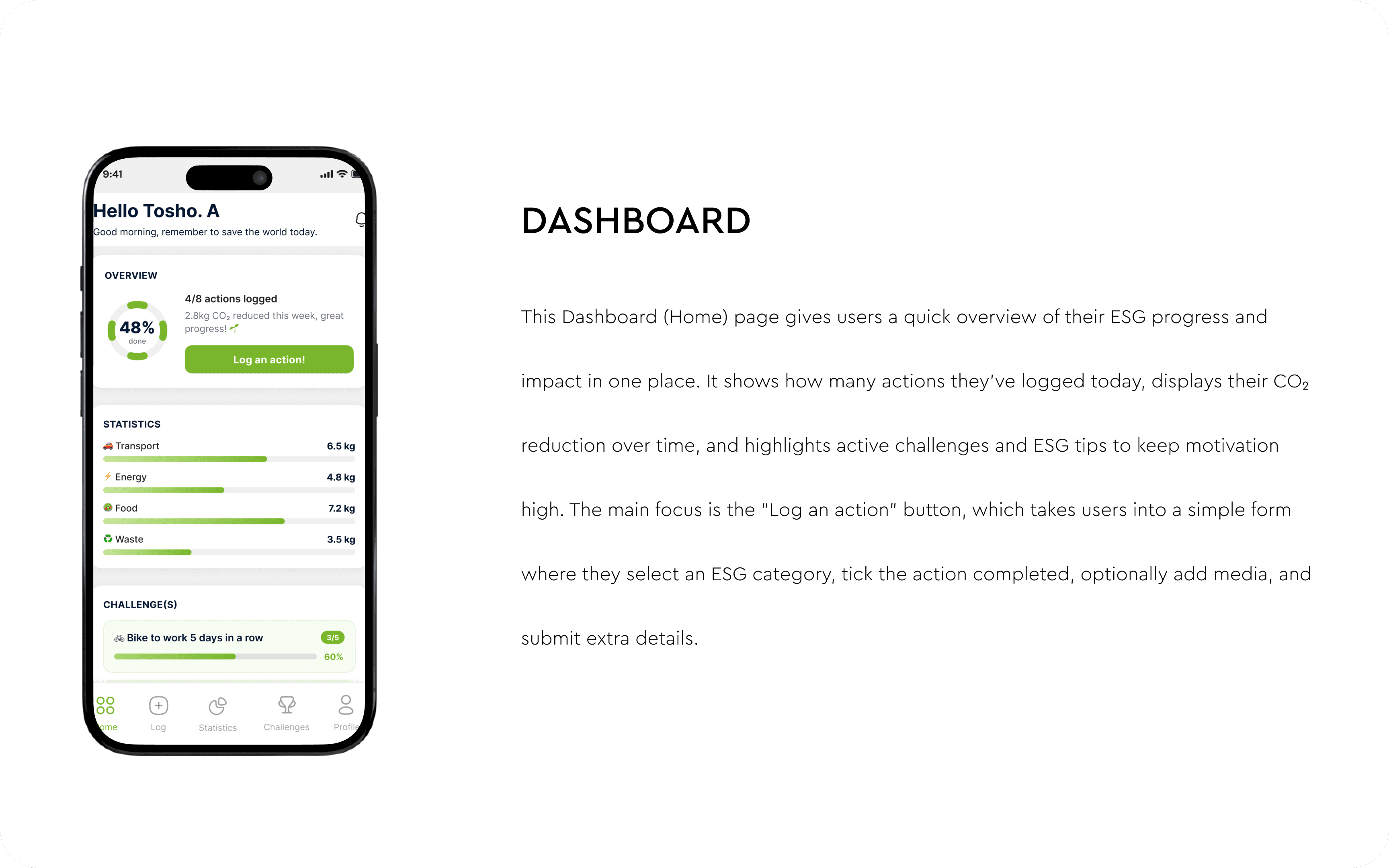
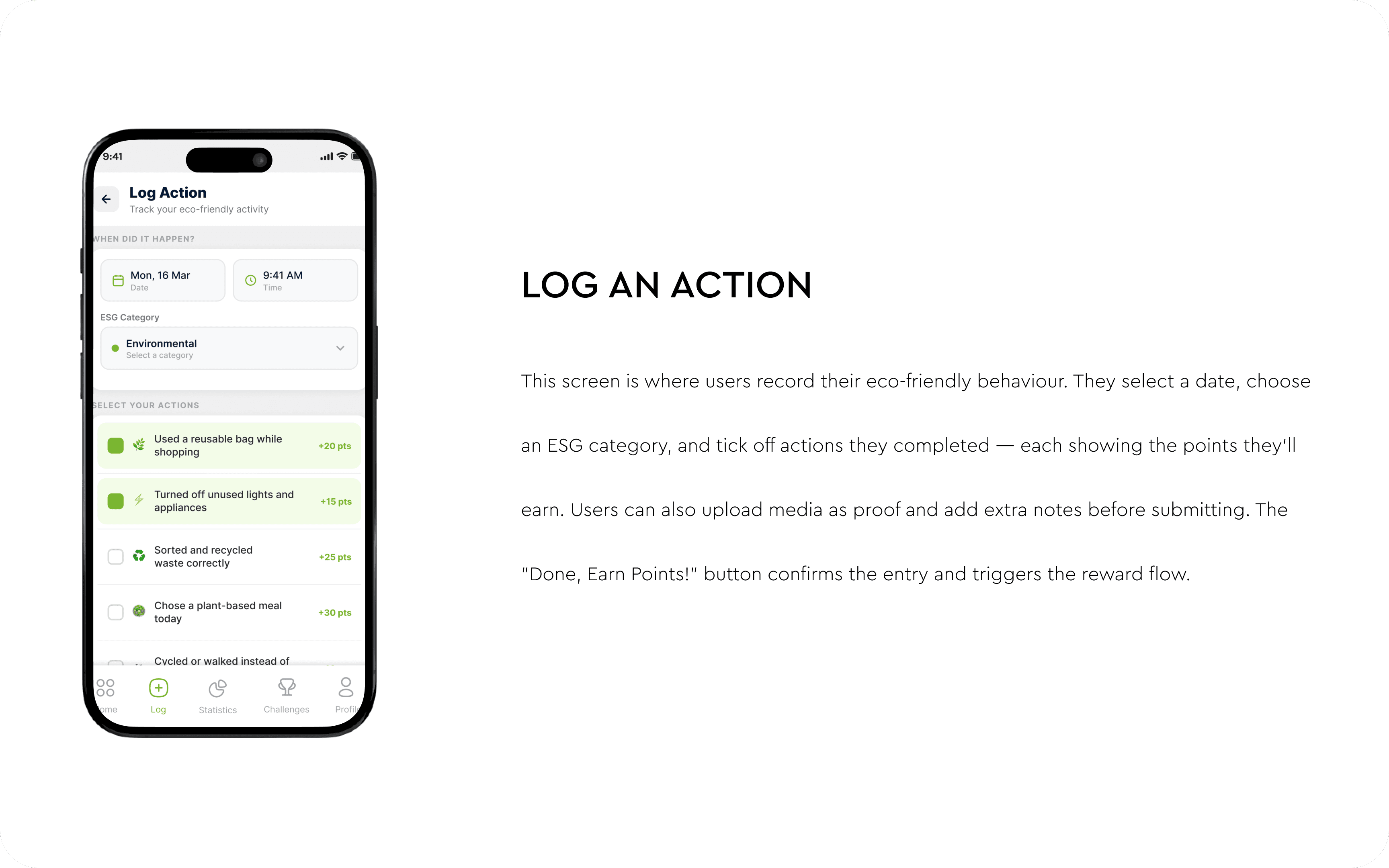
Log an Action: A quick recording of eco-friendly actions (with optional proof and details).
Impact Dashboard: Shows environmental impact over time with simple statistics and graphs.
Challenges & Goals: Structured challenges like “zero-waste week” to keep users engaged.
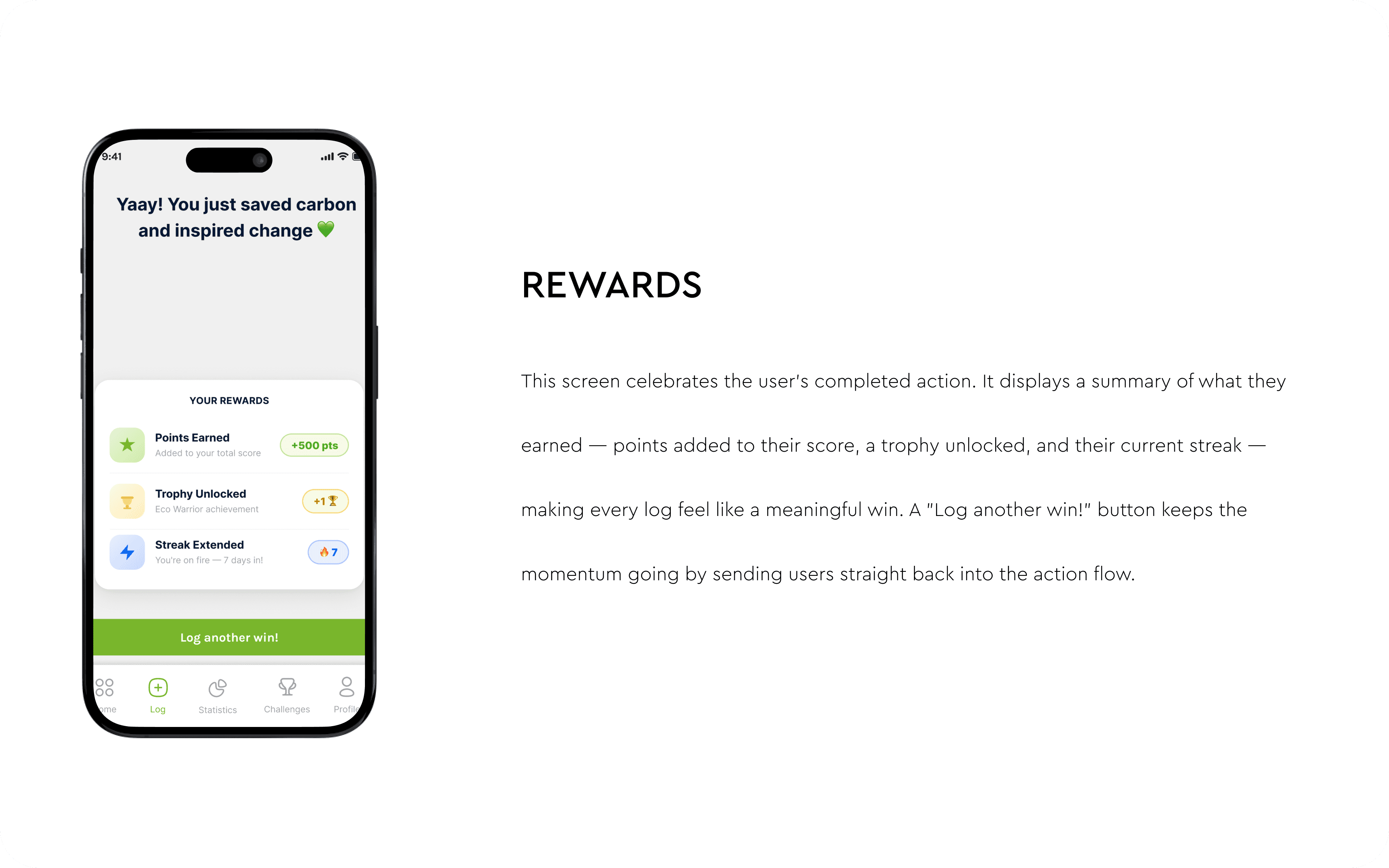
Points & Badges: Rewards users when they log actions or reach milestones.
Eco Tips: Guides users with sustainability tips and content.
Calendar Integration: To fit into a user’s day with contextual suggestions and reminders.
Real-time feedback: For instant encouragement (e.g., “You saved 1kg of CO2 today”).
Smart reminders: Prompts users to log, complete challenges and share progress.
CORE USER FLOW: "LOG AN ACTION"
This is the heart of the product:
User lands to the home screen
Taps "Log an Action"
Select ESG category
Select action (e.g., turned off idle electronics, used reusable cup, avoided printing)
Adds optional proof (photo) + additional notes
Submits and receives confirmation + points + streak feedback
Usability Testing
To validate the core experience, I tested a low-fidelity prototype remotely via Zoom. Users were asked to complete the core task: log an ESG action while I observed friction, confusion points, and time-to-completion. I tested with 30 users.
Metrics Used
Task success rate
Time on task
Error rate
Quality Feedback
Findings: What Failed in Version 1
The first test produced a weak result because users couldn’t log an action immediately. The “log” option was not front-and-center, so users had to search through the bottom menu and found the experience stressful and not seamless. They also clicked “view statistics” because it looked like the primary call-to-action.
Version 1 results
Task success rate: 33.3%
Time on task: 5 minutes, 42 seconds
Error rate: 67%
Feedback included confusion about why logging couldn’t happen directly from the home page.
Iteration: What I Changed
Users made it clear: logging is the main task, so it must be the easiest action to access.
Design fix: I replaced the “view my statistics” CTA on the home screen with a clear Log an action button in the overview area, making the primary task instantly reachable.
Results: Version 2 Testing Improvements
After the change, results improved significantly.
Version 2 results
Task success rate: 100%
Time on task: 2 minutes, 42 seconds
Error rate: 0%
Qualitative feedback included: “This is cool” and “felt better and easier.”
This iteration confirmed a core UX lesson: the primary user action must be visible, immediate, and frictionless.
Assumptions and Considerations
For a real-world rollout, I assumed:
Integration with internal systems (e.g., HR platforms)
Internal communication support for launch and adoption
ESG KPIs exist that the app can track and visualise.
future versions will expand beyond Environmental into Social and Governance actions over time
Future Roadmap
To become a complete ESG engagement tool, the product can expand into:
Social integration
Join mental health sessions
Volunteer time
Participate in DEI workshops
Donate via the mobile application
Governance integration
Training on cybersecurity/ethics
Corporate transparency webinars
Making EcoTrack Profitable (Optional Business Direction)
EcoTrack could become a scalable product through:
SaaS subscriptions for medium/large companies with ESG budgets
Custom ESG reports for audits and tracking employee-led actions
Selling across industries where ESG reporting matters
Integrations with tools like Microsoft Teams, Slack, Google Workspace
Lesson Learned
Primary tasks must be front-and-center. When “log an action” was buried, adoption failed; when surfaced, usability succeeded.
Motivation is a product feature. Feedback, rewards, and challenges aren’t “extras”—they drive repeat behaviour.
Iteration beats assumptions. Testing revealed friction quickly and gave clear direction for improvement.


